













Female Genital Mutilation in Iraqi Kurdistan
Presentation to the conference: 1ère Journée Humanitaire sur la Santé des Femmes dans le Monde organized by Gynécologie sans Frontières, Paris May 8th 2006
Sandra Strobel and Thomas v. der Osten-Sacken, “Female Genital Mutilation in Iraqi Kurdistan,” KWAHK, 27 March 2006.
First of all, we want to thank you for this invitation giving us the possibility of speaking with you about a widely unknown topic: the existence of Female Genital Mutilation in Iraqi-Kurdistan.
Our NGO is working in Northern Iraq since 1993.
The Kurds have lived decades of war, forced resettlements, mass-murder and Diaspora.
Iraqi-Kurds have experienced decades of political decay, wars, sanctions and economic recession. Iraq, a country rich in natural resources, was systematically destroyed and impoverished. The Ba’ath dictatorship during its three decades of ruling moulded and totally changed Iraq’s society. Consequently only 53% of Kurds has frequented school- this means that they have frequented primary school for about 5 years in the best of all cases. 34% of Iraqi Kurds are illiterate.
These figures are even higher for women.
Women were one of the first victims of this policy. Due to several reasons they suffered most under political oppression, wars, economic decay.
Additionally they are victims of male violence. Often they are not allowed to freely choose their husband, to travel alone, to work. Sexual harassment and abuse inside families are not openly discussed. Many women suffer under psychological problems up to severe traumata. Abused women are regularly regarded not as victims but as guilty and shameful; women in distress are often classified as mad. Kurdish society is a very patriarchal kind of society. Girls are part of the family’s honour. This is only one of the reasons why Kurdish women and girls are subjected to a strict rule. Many women have never consulted a doctor. Forced marriage, violence of all kinds, honour killing and suicide are quite usual in this region.
WADI supports various projects for empowerment of women in Northern Iraq.
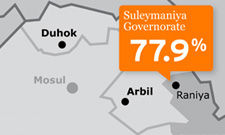
Iraqi Kurdistan is a quite rural area where a big number of women can’t benefit of medical assistance. This is why we have created female lead mobile teams to mention just one of our various projects - that consist in one female doctor, a nurse and a social worker. These mobile teams visit even very isolated villages and offer medical services to the women. After one year and a half these teams had conquered the faith of the villagers who started to talk about FGM with the team. This is when the team made a horrible discovery: a big part of the women had been mutilated. They questioned about 1544 women and young girls. 907 of theses women and young girls are victims of FGM.
This is why WADI decided to start a special program against FGM.
FGM is a taboo in Kurdistan. In former times, people never talked about this subject. This painful mutilation is usually done to young girls aged between 4 and 12 years. It is a secret act about which people never talk. There is neither present neither party. Women want to get rid of the ‘haram’ (dirty) organs of the girl the most quickly and secretly as possible.
The fact that its own mother is handing out the girl to the woman that excises the girl is very traumatizing for the girl. Normally a female member of the family, a neighbour or a traditional woman is cutting the girl. Sometimes it is even the proper mother that is cutting the girl.
The operation is done without any kind of anesthetization. As the women committing this act have no medical knowledge, there is no sterility of the instruments used. She cuts the clitoris and sometimes parts of the labia, using a razor or a knife. Then, she covers the bleeding wound with ashes. The girl is sometimes forced to sit onto a bucket filled with icy water. Many girls die or suffer during their whole life of the psychological and medical consequences of FGM. Many of them can never forget this shock situation.
We won't talk about the medical and psychological consequences of FGM now, because you are doctors and you are very well informed, but we want to insist on the fact that many girls in Iraqi Kurdistan die of bleeding after being mutiliated.
Why do women practise FGM in Iraqi Kurdistan?
Most women justify this act by tradition and religion.
Others confess that they believed that Islam obliges women to practise FGM.
Some women say that they practise FGM because « it has always been like that ». They think that they do something good for the young girls. The clitoris is considered to be a ‘haram’ (dirty) and ugly organ. Lots of women are frightened that they cannot marry find husbands for their girls if they haven’t been cut.
Islam doesn’t transmit us a clear message about FGM. There is a variety of possible interpretations. This is why some Islamic schools say that women are not obliged to practise FGM: But lots of Islamic schools still teach that FGM is an obligation for every Muslim woman. The fact that many rural mullahs in Iraqi Kurdistan tell the Muslim women to practise FGM is one big problem.
But first let us discuss, why suddenly people start to speak out about FGM. Why nobody before was informed about this practise in Iraqi Kurdistan? And is Iraqi Kurdistan an exception within the Middle East? Isn't FGM practised in other Middle Eastern Countries?
To find answers, we should have a closer look on the close connection between freedom and civil liberties in the Middle Eastern countries and the possibility to struggle against FGM and against other kinds of violence against women.
FGM and Freedom
If we look at studies and documentations that have been done about FGM over the last decade, we’d be surprised that none is mentioning the problem of FGM in the so called Masreq Countries, the Arab region east of the Suez channel. Let us pick an example. In spring 2004, the Austrian Foundation for World Population and International Cooperation published a report that gave an overview of countries in this world, where FGM is common. No country of the Mashreq is mentioned - except Yemen ‘ and many people see this country as a kind of bridge between Africa and the Middle East. Moreover, some scholars have asserted that this practice does not exist at all throughout this region. This information was simply wrong. FGM is not limited to the African part of the Arab and Muslim world. It is not an ‘African practice’. True, Egypt, where approximately 90% of all women are mutilated, is an African country; but it is an Arab and Muslim country, too.
The reason why they have been aware of FGM in Egypt and not elsewhere is not that Egypt is in Africa and only there FGM is practiced. The reason that this form of violence against women has been hidden so well is, we believe, a rather different one. Although Egypt cannot be called a democracy it is less autocratic than most of its neighbours. A variety of Civil Society Organizations, Women’s and Human right groups can work there. In dictatorships like Syria or in Saddam’s Iraq even such freedom does not exist. Even worse, these dictatorships sometimes legalized such violence in different forms. In Iraq, for example, so called Honour Killings were legalized in the late 80s.
Things simply looked different in the Kurdish regions of Iraq that were able to free themselves from Saddam´s rule in 1991. Although freedoms were still very limited under the government of the Kurdish parties, slowly some space was created during the 1990a for an embryonic civil society.
If in 1992 a Kurdish official had been asked about forced marriages, honour killings and other forms of violence against women in the Kurdish controlled areas of Northern Iraq, he’d probably denied their existence. However, women’s organizations and other CSO’s started to make facts public. They collected data, opened Women Shelters and lobbied the parliament. And in 2000 honour killings were banned in Kurdistan. Throughout the region a variety of studies were done on honour killings, resulted in shocking findings. This is not because the Kurds are more backward or uncivilized than anyone else in the Middle East (as some Arab nationalist propagate). It is because the Kurds in Iraq have had the freedom to investigate and make the fact known, and even to confront certain taboos. Everything related to sexual discrimination or sexuality still is a huge taboo in almost all Middle Eastern countries.
Programs to combat FGM
It is possible to combat this violence against women. The story of the courageous initiative of local members of various women’s organizations and the local staff of WADI in Iraqi Kurdistan, who have found out that FGM is practiced and decided to struggle against it, is a hopeful story. In less than two years from their first findings about the practice, they have made this unspoken of taboo, to a public and politically recognized problem- just very recently the first conference on this issue took place in Arbil, the Kurdish capital. This is also a story about how certain freedoms are so closely connected to all the activities to combat violence against women. We?d like to tell you this story briefly: what has been achieved and how, as well as how much more there is to do.
When our teams discovered FGM in Iraqi Kurdistan, every one of us was shocked and paralysed. What can we do against this widespread practise in Iraqi Kurdistan? How can we save the physical and psychological integrity of thousands of young girls?
After they presented these shocking results (and even professionals inside Suleymaniah thought back then this was exaggerated) we started to discuss measures to raise awareness to FGM and at the same time to put some pressure on regional authorities to recognize this problem. The majority of villagers in Germian area is illiterate and has no access to TV or radio. The Germian Regional Program members suggested to produce a locally made educational film and to interview mullahs as well as doctors to show that neither Quran subscribe to Mutilation nor any medical benefit results from this practice.
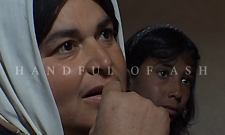
Luckily a local team of filmmakers was ready to produce such a film and working closely together with the Mobile Teams in Germian they finished a 30 minutes educational film in summer 2005. This film was made possible with the help of a Spanish co-operation partner.
In the meanwhile a Kurdistan-wide research was prepared in c-operation with the Universities of Baghdad, Suleymaniah and Arbil. Unfortunately until now no donors? organisation was found to support this research. The basic idea is to questions about 5% of the female population of Iraqi-Kurdistan in order to get a comprehensive overview about where and how FGM is practiced.
The activists in Kurdistan found important support from a British Journalist who started to extensively write about FGM and spread this news especially in the English speaking media. This helped them a lot and gave them support against various attempts to silence them.
In October 2005 a first Team started to show the film in 20 selected villages in Germian. The success was striking: a lot of women explained they didn?t know before this practise was not obliged by Islam. Especially the Interview with a high rank Mullah shown in this film convinced a lot of women, although some still claim this practice is necessary and right.
With support from the Swiss Caritas this team is now working in Germian region on a regular base.
And in co-operation with the Iraqi Civil Society Program our branch in Arbil started similar activities with this film and did another small research in Arbil-area. Here the rate of mutilated women was even higher.
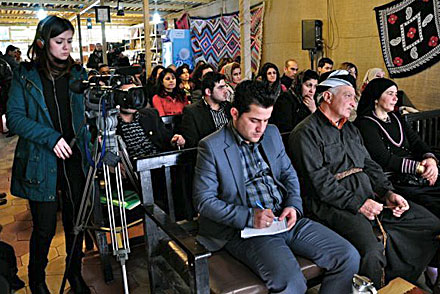
On Saturday 26th 2006 we held a conference in Arbil that was supported by the same local authorities who before claimed no FGM exists in the region. 90 women participated as well as all the local media. They elected a committee of five doctors and professors, who will propose a new legislation to the Kurdish Parliament in order to ban FGM by law and start a awareness campaign in schools, hospitals and the media.
Thus only after 14 month of activities with a very limited budget and against wide-spread resistance these local activists succeeded: Now officially FGM is recognized as a problem in Iraqi-Kurdistan. This is a first, but very important step, not only for Iraqi-Kurdistan itself, but the whole region.
Just recently a member of a semi-legal Women organization in Syria told us, they do have FGM to, but until now no chance to address it.
With these activities in Iraqi Kurdistan, that were conducted by a courageous group of Kurds ‘both men and women’ it is now known and proofed that FGM is not solely an African problem.
Empowerment of women and the combat against Violence against Women should be at the core of any transformation of dictatorial societies into democracies. Only then an opportunity is opening to help local activists to stand up for such universal values as equality.
It’s up to us to support and consult all those, who are in the middle of this struggle.
They do have a lot of enemies and unluckily only few friends in Europe. We hope after listening to this story they found more here today.